Nokogiriyama Art Museum
Exhibits works on the theme of “Kanaya, a town of stone and art”. Special exhibitions rooted in the local community are also held from time to time.

Awa Onsen | Kinokuniya
Kyonan, the town south of Mt. Nokogiri
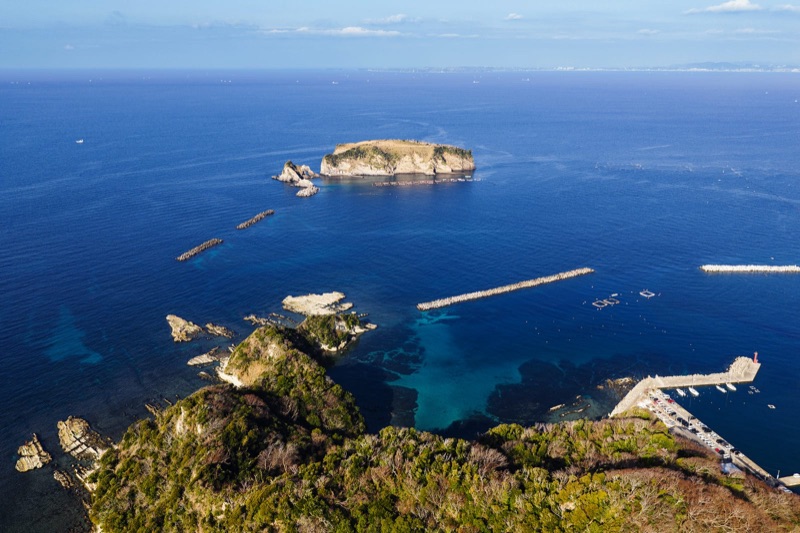
Kyonan was formed in 1959 by merging the castle town of Katsuyama with the port town of Hota. The name means “the town south of Mt. Nokogiri”. It sits at the gateway to Minami-Boso and has two fishing ports, Katsuyama and Hota, where fresh fish and shellfish are landed every morning.
Minamoto no Yoritomo is said to have landed here after his defeat by the Taira clan and to have regrouped for his comeback. The Yoritomo Festival is held every October, and the Yoritomo cherry blossoms are at their best from February to March.

Mt. Nokogiri rises on the border between Futtsu and Kyonan, at the western end of the Kiyosumi range. Its jagged, saw-toothed ridge has long served as a landmark for ships entering Tokyo Bay. The mountain, with its sweeping views over the sea of Minami-Boso, can be reached by ropeway or by car.
The Great Buddha of Nihonji, Japan's largest seated stone Buddha, and the Jigoku Nozoki “Hell Peek” are well worth seeing.

The ropeway takes you easily to the 329.5 m summit, where the Jusshu Ichiranda viewing platform offers 360-degree views.
Regular hours: 9:00–17:00 (16 February–15 November)
Winter hours: 9:00–16:00 (16 November–15 February)
*Extended hours in summer
[Access] about 20 min by car from the inn
[Details] Nokogiriyama Ropeway (official site)

With its mild climate, Kyonan is known as a town where flowers bloom all year round. Japanese daffodils begin to bloom in December, followed by the Yoritomo cherry (Kawazu cherry), and in spring the Somei Yoshino cherry.
Exhibits works on the theme of “Kanaya, a town of stone and art”. Special exhibitions rooted in the local community are also held from time to time.

As its name suggests, the café stands on a cape (misaki) at the foot of Mt. Nokogiri and was the model for the film “Fushigi na Misaki no Monogatari” (The Tale of the Mysterious Cape). Coffee time gazing out over the wide sea in a retro atmosphere is pure bliss.

A roadside station lined with local specialities, farm produce and seasonal flavours. It is also the “Highway Oasis Furari” express-bus stop; if you come by bus we will pick you up here (from 14:30, reservation required in advance).

The former Hota Elementary School, its days as a school over, was renovated and reborn as a roadside station. The building keeps the feel of a primary school and houses a farmers' market, lodging, restaurants and more.

The terraced rice paddies closest to Tokyo, where rice is still grown today amid a nostalgic satoyama landscape. Enjoy the scenery of each season: the breezy planting season, the golden harvest, and rows of red spider lilies. In autumn, the torch-lit “Tanada no Yomatsuri” night festival and the “Tanada no Akari” illumination are held.

Enjoyable over a long season from January to early May. There are many strawberry farms near the inn.

Some 10 million daffodils blooming across the mountain slopes make a spectacular sight.

From late December to January, hundreds of thousands of daffodils bloom on the slopes along the road.

Prefectural Route 182 is known as Momiji Road for its roughly 10 km of autumn colours, the latest to turn in the Kanto region, which can be enjoyed until around mid-December.

Linking Kurihama Port in Yokosuka with Kanaya Port, the Tokyo-Wan Ferry takes 40 minutes each way and is recommended both as transport and as sightseeing. Sailings roughly every hour except at night. A short voyage makes a lovely change of pace.

A large outlet mall on the shore of Tokyo Bay bringing together Japanese and international brands. A popular spot for fashion, food and entertainment.